2024-2025 Impact Summary
246
Students completed the program
24
Trained facilitators from various departments on campus participated
96%
of students on average responded “Strongly/Somewhat Agree” that they felt like a valued member of the dinner discussion
Highlights
The program was completed by 246 students 2024–2025 academic year (Year 2). On average, students responded “Strongly / Somewhat Agree” to the following:
- Structure and techniques used by the facilitators made for inclusive conversations: 96%
- I felt like a valued member of the dinner discussion: 96%
- I felt comfortable sharing my opinion: 95%
- The discussion provided opportunities for me to learn from my peers: 97%
Evaluation Executive Summary
Wisconsin Evaluation Collaborative (WEC) conducts an outside evaluation on our initiative every year through data collection and observations.
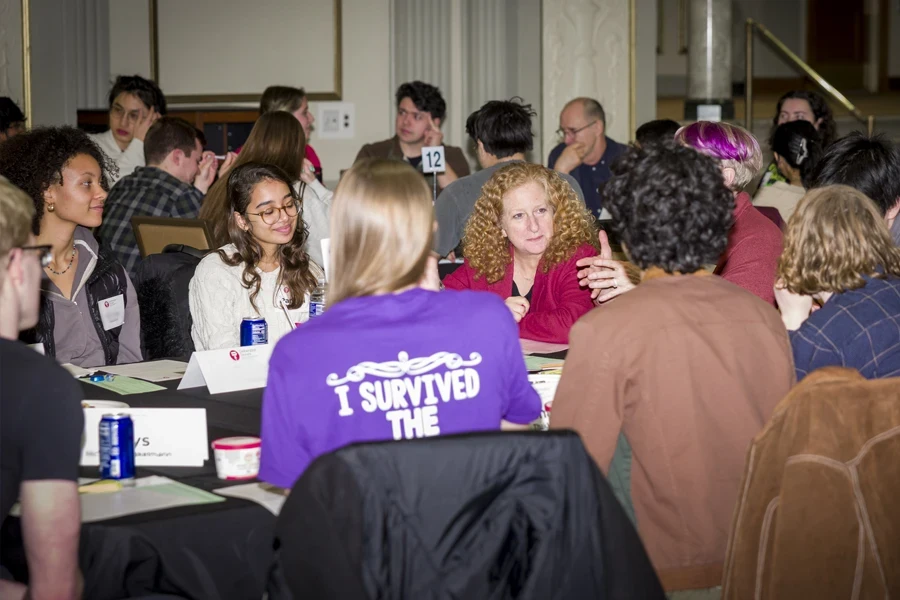
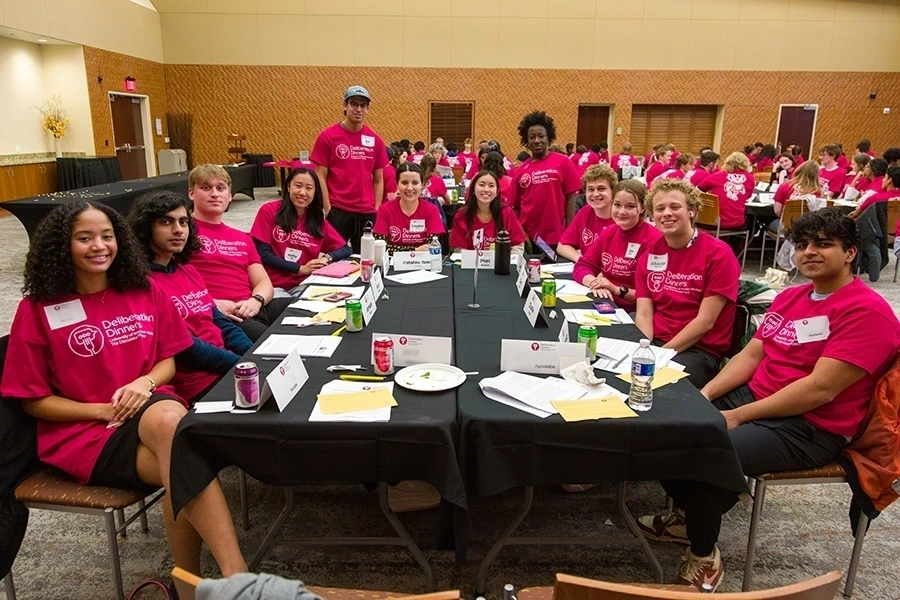
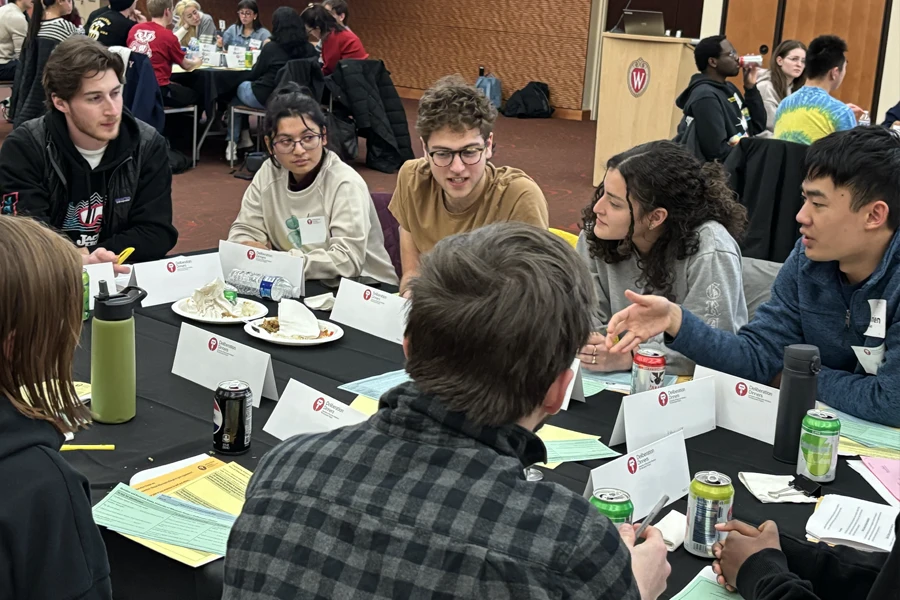
A truly transformative experience…
Students consistently described the Deliberation Dinners as a transformative experience that improved their ability to engage in civil discourse. A major theme was the development of stronger listening skills and greater open-mindedness.
One student shared, “I don’t interrupt as much, I wait and actually listen,” while another reflected, “It helped me be a better listener, honestly.” Many described a shift from reacting quickly to taking time to understand others’ views: “It made me reflect more before responding,” and “It slowed me down, in a good way.”
This shift also included deeper curiosity about differing perspectives. As one student put it, “I think I’m more curious now when people say something I disagree with,” and another added, “I started to try to understand why they think what they think.” These changes helped students move away from a need to “win” arguments. “Made me realize I don’t always need to be right, just to understand,” explained one student.
Observers also noted that students engaged in exchanges that indicated they were trying to listen and understand others’ viewpoints. For example, some of the student statements documented include: “Just to clarify, are you considering…;” “What I thought I heard you say…;” and “Can you elaborate…”
Respectful and calm dialogue was another key outcome.
Students noted that they became less defensive and more intentional in how they communicated. “I think that I am less defensive about it now than I used to be,” said one, while another shared, “Even when I feel strongly, I try to express it gently.”
Several students mentioned how tone and demeanor influenced the quality of their conversations: “Made me notice how much tone matters,” and “I try not to escalate anymore, I keep it low-key like we did in the dinners.”
These skills didn’t stay confined to the dinner table. Students reported applying them in real-life settings: “I think these skills that I’ve learned have definitely carried into how I talk about politics with my friends,” and “I tried it at Thanksgiving dinner and it actually helped!” Others mentioned using techniques like paraphrasing and acknowledging before disagreeing: “Now I use that technique of paraphrasing what someone said before responding,” and “I remember the ‘acknowledge before disagreeing’ thing, it really works.”
(Excerpt from the Year Two Evaluation of the UW–Madison Deliberation Dinners)
Issue Questions Discussed at Each Dinner
1. Should marijuana be legalized, regulated, and taxed in Wisconsin?
2. What should future U.S. foreign policy on aid to Ukraine be?
3. Should Wisconsin expand nuclear power generation capacity?
4. Should Wisconsin change its gun regulations?
5. What abortion policies should Wisconsin have?
6. What should Wisconsin do about school vouchers?
Dates & Locations
2024 Fall Semester
Location: Symphony Hall in Gordon Dining Hall on East Johnson Street
Group A (Mondays)
- Sept. 30, 2024
- Oct. 28, 2024
- Nov. 18, 2024
Group B (Tuesdays)
- Oct. 1, 2024
- Oct. 29, 2024
- Nov. 19, 2024
2025 Spring Semester
Location: Great Hall in Memorial Union
Group A (Mondays)
- Jan. 27, 2025
- Feb. 17, 2025
- March 3, 2025
Group B (Tuesdays)
- Jan. 28, 2025
- Feb. 18, 2025
- March 4, 2025
Faculty & Academic Staff Facilitators
Monday Cohort
| Facilitator | Department | School/College |
|---|---|---|
| Ajay Sethi | Population Health Sciences | School of Medicine & Public Health |
| Carlos Benítez Barrera | Communication Sciences and Disorders | L&S |
| David O’Brien | Educational Policy Studies | Education |
| Diana Rodríguez-Gómez | Educational Policy Studies | Education |
| Jennifer Ratner-Rosenhagen | History | L&S |
| Jeri Barak | Plant Pathology | Agricultural & Life Sciences |
| Jerome Camal | Anthropology | L&S |
| Karen Kopacek | Pharmacy Practice and Translational Research Division and Office of Student Affairs | Pharmacy |
| LJ Randolph | World Language Education, Curriculum & Instruction | Education |
| Pam McGranahan | Nursing, Director of the Doctorate of Nursing (DNP) program | Nursing |
| Robert Nix | Human Development & Family | Human Ecology |
| Shamya Karumbaiah | Educational Psychology | Education |
Tuesday Cohort
| Facilitator | Department | School/College |
|---|---|---|
| Aja Watkins | Philosophy | L&S |
| Andrew Stevens | Agricultural and Applied Economics | Agricultural & Life Sciences |
| Catalina Toma | Communication Arts | L&S |
| Gwen Eudey | Economics & Finance, Investment and Banking | L&S |
| Joe Conti | Sociology | L&S |
| Kassem Fawaz | Electrical & Computer | Engineering |
| Maria Widmer | Administration | L&S |
| Mike Shapiro | Engineering | Engineering |
| Nathan Jung | Engineering | Engineering |
| Rahul Chatterjee | Computer Science | L&S |
| Rommel Javier Jimenez | Bachelor of Business Administration | Wisconsin School of Business |
| Taylor Odle | Educational Policy Studies | Education |
| Harry Brighouse (Sub for both days) | Philosophy | L&S |